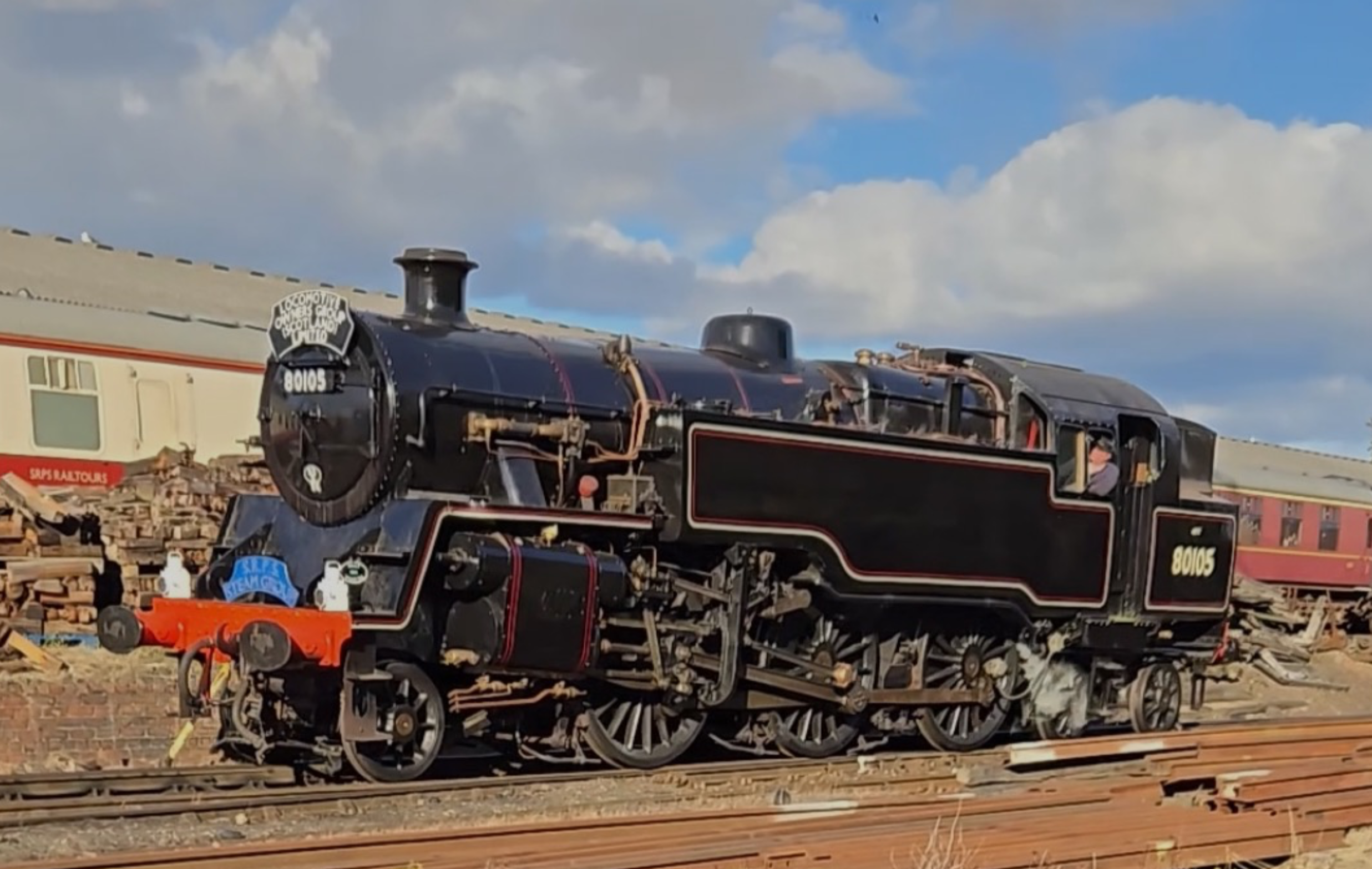
80105 a British Rail Standard Class 4MT Tank Engine
Purchased and Cared for by the Locomotive Owners Group (Scotland)
Ltd. aka (LOGS)
Built in 1955, at a cost of £18,206; the locomotive entered service with British Railways on 19th April that year. The engine is one of a class of 155 mixed traffic locomotives, introduced from 1951.
Photo courtesy of L Batchelor.
The engines of this class worked in all British Railways Regions, and were popular hauling suburban commuter trains, except on the Western, where they operated cross country trains in Wales.
All the Derby and Doncaster built locomotives were allocated to Scotland; in 1959 Polmadie (66A) had 20, Corkerhill (67A) had 8 and Kittybrewster (61A) had 11. 80105 was one of a batch constructed at BR Brighton Works and used originally on the Eastern Region’s London, Tilbury and Southend section out of Fenchurch Street until 1962 and then on the Cambrian section in north Wales until 1965.
Originally shedded at Plaistow (33A) in east London, the big tank was sent in November 1959 to Tilbury on the closure of the former shed and continued to work the LT&S until the electrification scheme was completed in June 1962. The locomotive was thus 8 years old when withdrawn from its intended duties.
It was stored at Old Oak Common from June to July 1962 and then allocated to the Western Region for use on the Cambrian Coast section. 80105 was then shedded at Machynlleth (89C and the shed for Aberystwyth), Shrewsbury (84G) and Croes Newydd (84J).
80105 had received an overhauled boiler (No. 1300) at overhaul in Crewe works in 1963 and this boiler was in very good order. The original boiler was No. 1334 and this is still in existence, on No. 80079 at the Severn Valley Railway.
Withdrawal
80105 was finally withdrawn from service July 1965. After withdrawal, it was sent to Woodham’s scrapyard in Barry, South Wales in January 1966. Upon arrival, its non-ferrous fittings were removed, but much was also left on the engine.
Preservation
80105 was inspected by members of the SRPS in autumn 1972 as an example of a class which saw extensive deployment in Scotland, and was chosen as the best surviving example. Most of the motion was fitted, and the connecting rods were safely in the bunker.
The inevitable fund-raising was carried out but it was not until the formation of a limited company, Locomotive Owner's Group (Scotland) Ltd., that the necessary capital was forthcoming.
In October 1973, 80105 was brought north by road and unloaded at Larbert, where it was inspected by BR. It was then passed as fit to travel by rail to the SRPS depot at Falkirk and this trip was accomplished without trouble, but with much castor oil on the axle bearings.
Upon arrival at Falkirk, the locomotive was fairly quickly dismantled and the frames taken into the shed. Work then came to a halt upon discovery that the rear frame stretcher, which carries the firebox, was corroded beyond repair, although an attempt was made to do this. Throughout the 1980s, there was little activity and the locomotive was then taken to Bo’ness on closure of the Falkirk depot in 1988.
Photo Courtesy of H Stevenson.
The Journey (See also the ('Journey North' Page)
The route taken by the haulage contractor ensured that 80105 will remain the only steam locomotive to have operated at Bo’ness that will have travelled under the old Crawyett Bridge on the A904 before the road was re-aligned to cross over the railway. Thus it has the doubtful distinction of having passed below the bridge as well as over it!
Once the Bo’ness workshop facility, the Romney Hut, was in full operation, 80105 was moved inside and restoration re-commenced in earnest in 1992. The locomotive was re-wheeled in 1995, and the boiler sent to Babcock for repair.
Castings and fittings were obtained, and the cab equipment duly removed from the loft of one member’s house, where it had reposed without detection from the domestic authorities for ten years!